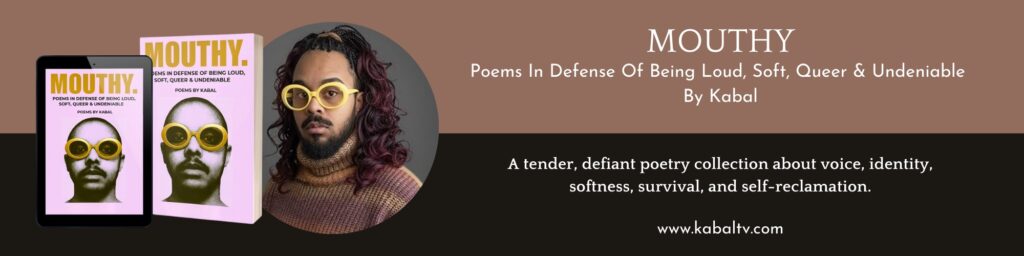
Kabal is a Black, queer storyteller, educator, and creator whose work explores identity, healing, and the courage it takes to live authentically. Through poetry, essays, and reflections drawn from lived experience, Kabal writes with tenderness and honesty about the intersections of queerness, body, culture, faith, and self-discovery. Their writing embraces both the quiet and the liberating moments of becoming, inviting readers into a space that is reflective, compassionate, and deeply human. Kabal lives in Washington with their husband, a beloved dog, and a confident cat who rules the household, where daily life is shaped by humor, community, and the ongoing practice of learning to love oneself out loud
Author Q&A
Tell us a little about yourself. Where were you raised? Where do you live now? Do you have any pets?
My name is Kabal, and I’m a writer, storyteller, and deeply layered person who has never really fit into one clean label. I was raised in a small rural town in Tennessee, and I live in the Seattle area now, which are two very different worlds. That distance between where I started and where I chose to grow up again lives in a lot of my writing. I also have an English Bulldog named Sarge, who has spina bifida, a stubborn streak, and the kind of presence that makes you feel like the room belongs to him.
Tell us about yourself and how many books you have written.
I’m a poet first, but really I think of myself as someone trying to tell the truth in a way that people can feel in their body. My latest published book is MOUTHY: Poems in Defense of Being Loud, Soft, Queer & Undeniable. My work tends to circle voice, identity, tenderness, survival, and what it costs to stay visible in places that would rather misunderstand you. I’m also working on other projects across poetry, personal writing, and work for younger readers, so I definitely do not plan on stopping at one.
What is the name of your latest book and what inspired it?
My latest book is MOUTHY: Poems in Defense of Being Loud, Soft, Queer & Undeniable. It came out of living with all the ways people try to name you before you get to name yourself. Too loud. Too soft. Too emotional. Too feminine. Too much. I wanted to write a book that did not flinch around any of that. I wanted it to feel honest, but still artful. Tender, but not fragile. Personal, but spacious enough that somebody else could walk into it and recognize their own life too.
How did you come up with the title?
I loved the tension in the word “mouthy” right away. It is the kind of word people use when they think someone has stepped outside the role they were supposed to play. It can mean outspoken, difficult, too honest, too emotional, too unwilling to sit down and be agreeable. That made it perfect. I wanted to take a word that could have been used to shrink someone and let it stand up straight instead. The subtitle helped make the invitation clearer. This book is not apologizing for being loud or soft or queer. It is defending the right to be all of it.
Do you have a specific writing style?
I do, though I think it keeps evolving the more honest I get. My writing sits somewhere between poetry, conversation, memory, and emotional confession. I like language that feels beautiful without becoming too precious. I want rhythm, but I also want clarity. I want a line to feel like it knows where to land. Some of my work is tender. Some of it has humor. Some of it has a little attitude because honestly, so do I. More than anything, I want the writing to feel alive, like somebody is actually there.
Are experiences based on someone you know, or events in your own life?
A lot of what I write is rooted in emotional truth, even when the exact details have been reshaped. I pull from lived experience, memory, identity, observation, and the strange little moments that stay with you longer than they should. Sometimes it is something that happened. Sometimes it is the feeling of what happened that matters more. I do not always write my life in a literal way, but I do write from a real one.
Is there a message in your novel that you want readers to grasp?
With MOUTHY, I think the core idea is that your voice does not lose value just because it unsettles people. I wanted to write toward the people who have been made to feel excessive for simply being visible, emotional, layered, or honest. The book pushes back against the idea that softness cancels out strength. It does not. If anything, choosing to remain tender after life gives you every reason not to is its own kind of power. I hope readers leave with that, but I also hope they leave asking themselves who taught them to edit their own voice in the first place.
What books/authors have influenced your writing?
I’m drawn to writers who are emotionally fearless and still precise. I love work that feels intimate without feeling messy, and lyrical without drifting away from meaning. I’m influenced by writers who trust the reader enough not to overexplain, but still leave something behind that lingers. Music has influenced me just as much as books, honestly. Artists like Jazmine Sullivan and Durand Bernarr have shaped my sense of rhythm, emotional honesty, and tone. Sometimes I think I write as much by ear as I do by page.
What are you working on now?
Right now I’m building outward. I’m continuing to grow The Many Channels of Kabal, which lets me explore writing, reflection, culture, and storytelling in a fuller way. I’m also working on new poetry, more personal narrative, and children’s poetry projects centered on identity, belonging, joy, and self-worth. I think I’m in a season where I’m less interested in staying in one lane and more interested in making sure every lane still sounds like me.
What does being a successful author look like to you?
Success, to me, is bigger than a sales number, even though I absolutely want the work to reach people. It means creating something that feels true enough to last. It means building a body of work that sounds unmistakably like me, not like who I thought I had to be to be taken seriously. It means somebody reading a page I wrote and feeling a little more understood, a little less alone, or maybe a little less willing to keep shrinking. I think success is when the work opens something, not just when it performs well.
Connect with the Author
Website: https://kabaltv.com
Book: https://www.amazon.com/Mouthy-Poems-Defense-Being-Undeniable-ebook/dp/B0GLQW8T3W
Facebook:
Instagram: https://www.instagram.com/FashionablyKabal