Born in southern Sweden, E.P.W Tell (Erik Pontus Weman) developed a lifelong fascination with history and Norse mythology, inspired in part by the landscapes that would later shape Birds of Ásgarðr, the debut novel in the Old Norse Saga series. His scholarly article, “The Curmsun Disc: Harald Bluetooth’s Golden Bull?”, deepened his exploration of Viking history and the mythological research of Viktor Rydberg, ultimately laying the foundation for the ambitious four-book saga. Recognizing the scope of the project, Erik partnered with co-author Camilla Beskow, and after five years of collaboration, The Old Norse Saga – Part One: Birds of Ásgarðr was born. In addition to his literary work, Erik holds a Master’s degree in Economics and a Bachelor of Laws, previously served as CFO of Svenska Bio, Sweden’s second-largest cinema chain, and remains active in athletics as a Strength & Conditioning coach for Swedish fencing and General Secretary of the Swedish Multisport Federation.
Growing up surrounded by books and stories, C. Beskow (Camilla) spent much of her childhood exploring forests in search of adventure before ending each day immersed in bedtime tales. With an imagination fueled by stacks of well-worn notebooks, she eventually transformed her passion for storytelling into a professional career. Drawn first to the visual side of storytelling, Beskow began her creative journey on the Swedish island of Gotland, studying screenwriting for film and television. In 2016, she founded her own company, working across translations, ghostwriting, and creative writing projects. Her collaboration with Erik Pontus Weman Tell on The Old Norse Saga sparked a deep fascination with Norse mythology, leading her into extensive research that unexpectedly revealed connections to her own literary heritage. Beskow’s family lineage includes celebrated Swedish authors Elsa Beskow and Elisabeth Beskow, as well as ties to mythologist Viktor Rydberg, whose interpretations of Norse mythology helped inspire the saga. A treasured family heirloom—an old edition of Snorri Sturluson’s Kongesagaer—continues to connect her to the ancient stories that now shape her work.
Author Q&A
What is the name of your latest book and what inspired it?
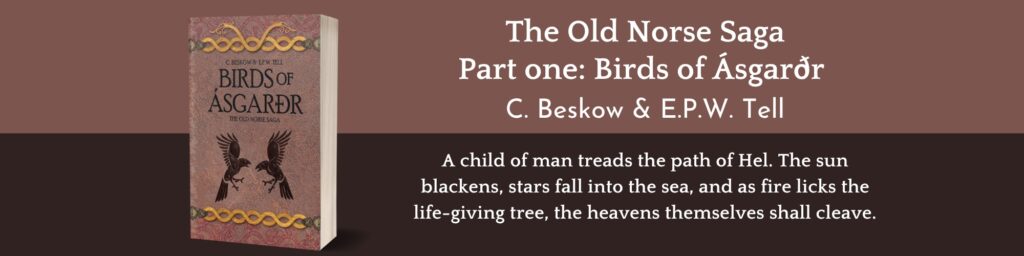
Pontus: Birds of Ásgarðr and it is part one of a planned four-book series called The Old Norse Saga.
In the summer of 2019, I borrowed a book called Our Fathers’ Godsaga: Retold for the Young, and it became my first encounter with the Viking myths presented as a unified narrative—written as literature rather than as an encyclopedic reference. Dialogue is sparse, but the experience is all the richer for it. It felt as though the origin of all fantasy was unfolding before me. All nine worlds are described—both geographically and thematically—with a level of detail that lingers long after reading.
I began drawing the worlds by hand, mapping them across three charts arranged on different horizontal planes:
– The Underworld, with the Deep Valleys, the Realm of Urðr, Mímir’s Realm, Niflheimr, Vanaheimr, and Ljósálfheimr;
– Earth, with Miðgarðr and Jǫtunheimr; and
– Ásgarðr.
For me, the reading became something of a calling. I was reading the book while staying at the mountain station in Saltoluokta, in the very region that prominent characters in our own story would later come to travel through. Already then, a powerful conviction took hold of me: this story had to be told again, in a modern voice, for a new generation of readers.
I wanted publishers to understand that. They did not—but the book was written nonetheless, thanks to a breakaway initiative from the Polish publisher Black Sheep. And the most important piece of the puzzle fell into place when Camilla Beskow took on the collaboration with me. To follow her development from the very first drafts has been pure magic—just like the story itself.
Camilla: When I initially read Pontus’ notes for the book, I knew very little about Norse mythology. It all felt rather daunting, with so many names and factoids. That led me to a deep dive in the subject and I’ve truly enjoyed developing my own interpretation of such old and amazing stories.
What is the best advice you have ever heard?
Pontus: If you are strong you need to be kind.
Camilla: Don’t get it right, get it written.
This is something I struggle with to this day. If I try to perfect the first draft of each chapter, I’ll never finish them, so I try to focus on getting them written roughly first and then I put a lot of work in when it comes to editing.
What are you reading now?
Pontus: Norse Goddesses: New Interpretations of Pre-Christian Mythology by Britt Mari Näsström. This is part of the research for part two in The Old Norse Saga; Iron Nights.
Camilla: The Mars House by Natasha Pulley. Her phrasing is delightful.
Do you see writing as a career?
Pontus: No, not for me personally. I see myself more as a co-author than an author, and it’s hard to imagine writing with anyone other than Camilla. This project is also a long-term commitment — the first part took five years to complete. Hopefully there won’t be another five-year gap between the books, though. And between us, we’ve already written 14 chapters of part two.
Camilla: Absolutely. I’ll probably always write in some capacity.
If you had to do it all over again, would you change anything in your latest book?
Pontus: No, but after three years we had a final version of the book when we commissioned two Beta-readers outside of Sweden. That gave us two more revisions of the book and we are really glad for that.
Camilla: My answer to that question could never be “no”. There are always sentences that could be more polished and parts that could do with more work. When it comes to this particular book, I would perhaps like to clarify certain details in order to make the reading experience more relaxed. Overall though, I’m very happy with the end product.
Can you share a little of your current work with us?
Surrounded by a light green forestland bordered by a circle of blooming alps, the Asynjan home represented all things maternal. It was a place where birds chose to lay their eggs and where vibrant dragonflies clung to their partners as if fastened on top of one another.
Here, protected from well wishes and expectant smiles, a ten-year-old Æsir lay on his belly amongst a sea of pink fireweed. Air buzzing with life kissed his cheeks in warm, affectionate gusts as his eyes followed the gentle flight of a plump bumblebee hopping searchingly from flower to flower.
‘You can live your life so peacefully here,’ Þórr whispered softly as he placed his stubby index finger next to the insect, allowing it to crawl weightlessly onto it, ‘with no one expecting anything of you.’
As the young Æsir watched the small, hesitant legs move across his finger in examination of its fleshy surface, his fondness for the little fellow was accompanied by a pang of jealousy. Imagine being able to focus only on the search for sweet Vingólf nectar, oblivious to any sense of identity or obligation.
‘Ready to meet your defeat?’
Þórr twitched at the sound of his youngest brother’s voice, and the bumblebee lifted from his hand never to land on it again. Within moments, it was forgotten.
What genre do you consider your book(s)?
Historical Fantasy. Unlike modern epic fantasy such as A Game of Thrones or The Lord of the Rings, which build largely original mythologies and settings, Birds of Ásgarðr aims to stay closer to the spirit, worldview, and narrative traditions of the Norse sagas and Eddic sources. Because of that, the book sits at the intersection of fantasy and historical fiction: a mythologically faithful retelling that treats Old Norse legend as a living historical and cultural tradition.
Do you ever experience writer’s block?
Camilla: Of course, it’s part of the writing process (perhaps not the most enjoyable part…). For me, what brings me back is usually some tiny detail that I fancy describing. If I put the laptop aside for a day and go outside instead, I often hear or see something that I wish to put into words, and then suddenly the notebook comes poking back out.
What would the logline be for your book?
In an ancient world on the brink of colapse, a young viking girl plays a bigger part than even Odinn himself could have ever predicted, but in which direction shall her choices come to tip the scales?
The Old Norse Saga – Part one: Birds of Ásgarðr is available for purchase on Amazon.
Visit the book’s website at http://www.theoldnorsesaga.com/