
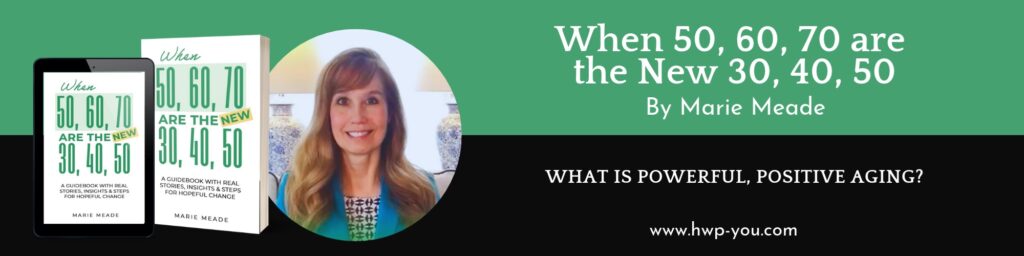
Marie Meade, M.B.A., is the Founder of HWP-You, a source of research- and experience-based ideas on powerful, positive aging. Her writing contributes to understanding how to pair constructive positive thinking and good health with a longer life. Her weekly emails are described by readers as “thought-provoking,” “inspiring,” and “well-researched.” The foundation on which her life-enhancing writing rests has been built by decades of wide-ranging reading, doing, and observing—from physical, mental, and spiritual health and longevity practices to business, personal relationships, and creativity. Her multiple life and work experiences include: * Entrepreneur creating products resulting in thousands of satisfied customers in 20 countries * High-performing revenue + profit contributor at a Fortune 25 company * Former foster parent * Adult daughter sharing the care of a 93-year-old parent, who lived with Marie from ages 89-91 years. * Early-stage breast cancer survivor * Wife of 30 years and going… * Sister of a sibling in his early 50s who unexpectedly died from an abdominal aneurysm * Scholarship student at Georgetown University * Overseas Undergraduate studies and Graduate Fellowship Awardee (England; Taiwan) * Grateful and enthusiastic active dance fitness participant Describing herself as a newly-minted (in 2025) 70-year-old going on 55,” Marie invites you to consider the potential benefits of fresh thinking about aging and the steps for making those years remarkable and satisfying.
Author Q&A
Do you like audiobooks, physical books, or e-books better? Why?
I’m rather attached to physical paper books. It’s what I grew up with and I have memories of many fulfilling hours entering new lives, experiences, and worlds through books. It’s hard to uncouple those imprinted pleasurable hours with holding paper books. They automatically, through years of repetition, engage a fuller sensory encounter of someone else’s thoughts and creativity. Touching and turning individual pages, writing notes, or highlighting expressions or phrases that resonate or grab me. I still have some paper books from my college classes in the early 1970s that spoke deeply to me.
What is your favorite movie and why?
I have a number of them, depending on whether it’s more serious or light-hearted. One that moves me both in aesthetics and content based on a real person is “The Man Who Knew Infinity.” It’s a beautifully rendered biography of Srinivasa Ramanujan, the formally-uneducated genius from Madras, India, who intuited the solutions to an astounding number of mathematical formulas. When others asked how he knew the answers without having been trained, deeply spiritual, he said they often came in dreams from God. He was the first Indian to be a Fellow of Trinity College at prestigious Cambridge University, amidst racism in the early 1900s. Tragically, he died at the age of 32. I love it because it’s based on a real person whose life and work embodied the mystery of unbidden genius that advanced human knowledge in what we now consider a short life.
What behind-the-scenes tidbit in your life would probably surprise your readers the most?
I really enjoy learning Afro-pop and hip-hop dance steps, and am still having fun doing it at 71.
Do you have a specific writing style?
I suppose my current writing style would be considered a blend of expository (“intended to explain, inform, or describe something in a clear, objective way”) and real-world storytelling to support sharing information I hope will be of value, especially to those experiencing some level of pain and suffering. It wasn’t a style I set out to adopt—it was organic. In the 10th grade I received an award I didn’t realize existed for expository writing, which indicates a natural bent toward it.
What book are you reading now?
For writing fuel and research, I often have my mind on sections of a number of books, which can include Business, the Bible,Biography, Health, Christianity, Psychology, and others.
The last book I read for pleasure was “I, Julian: The Fictional Autobiography of Julian of Norwich.” She is acknowledged as the first woman to write a book in English (vs. Latin) which meant more “everyday people” had access to her writing. She lived in the 14th century and later became an Anchoress (a mostly isolated Christian Church figure devoted to prayer) after surviving near-death and having mystical visions.
If you had to give up either snacks and drinks during writing sessions, or music, which would you find more difficult to say goodbye to?
It would be difficult to give up something to sip on. Music can be a distraction if I’m writing alone in a room and there’s music playing that I enjoy. It competes with the focus I normally need if I’m writing a first or early draft of a piece.
Connect with Marie Meade online at
Website: https://www.hwp-you.com/kickstart
LinkedIn: https://www.linkedin.com/in/mariemeade/
When 50, 60, 70 are the New 30, 40, 50: A Guidebook with Real Stories, Insights & Steps for Hopeful Change is available for purchase on Amazon. https://www.amazon.com/When-50-are-New-Guidebook-ebook/dp/B0DNWZM5PF