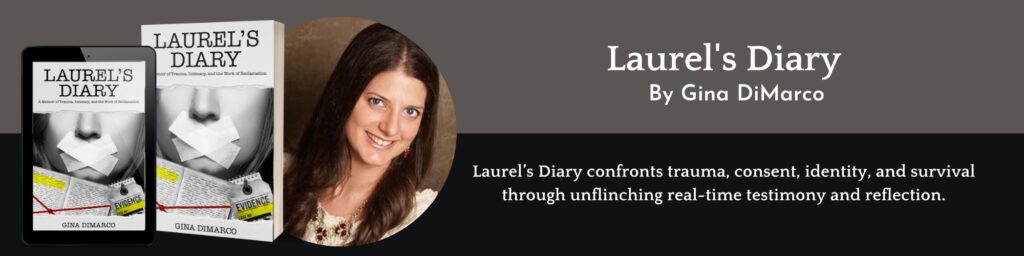
Gina DiMarco is a writer whose work explores trauma, intimacy, and the complex process of rebuilding a life after disruption. In Laurel’s Diary, she draws from lived experience to examine the long aftermath of sexual assault, offering a psychologically nuanced account of how trust, identity, intimacy, and relationships are reshaped over time. Her writing is marked by intellectual candor and an unflinching commitment to emotional truth, resisting easy narratives in favor of a more honest portrayal of healing as an ongoing process.
In addition to her memoir, Gina has written several children’s books inspired by her five sons, creating imaginative stories that reflect the curiosity, humor, and wonder of childhood.
Author Q&A
Why “Laurel’s Diary” and not “Gina’s Diary?”
When I first compiled this memoir, I planned to publish it anonymously. I chose the name “Laurel” to protect my privacy, but also because “Laurel’s” echoes “laurels,” the wreaths once given to victors in the ancient Olympics.
This process has felt like a marathon, and holding this book in my hands is proof that I finished it. Seeing it resonate with other survivors and spark badly needed conversations has become my victory. Those are my laurels.
Is there a message in your novel that you want readers to grasp?
I want readers to understand that trauma isn’t a singular event. It continues through memory, relationships, identity, intimacy, anger, grief, and the ordinary tasks of living life.
I also want readers to understand that survival is not a clean, inspirational arc. It is messy, contradictory, and deeply human. There is no perfect way to recover, no single timeline, and no version of healing that makes the harm acceptable.
For survivors, I hope this book feels like evidence that they are not alone. For those who love survivors, I hope it offers a clearer window into what trauma can do beneath the surface. And for everyone else, I hope it starts the harder conversations we should have been having all along.
How much of the book is realistic?
Fun fact: while the entire memoir is lifted from real diary entries, emails and texts, one agent felt that my husband, Chris, was an “unbelievable character.” I laughed when I received that feedback because he’s not a character; he’s my husband.
That said, I couldn’t wait to share that feedback with him because I am always calling him a unicorn. His combination of intelligence, emotional maturity, and general disposition is so rare. So to have an agent label him as “unbelievable” was validating. I now call him an “unbelievable character” from time to time. He does not appreciate that nearly as much as I do.
Is there anything you find particularly challenging with writing?
Writing, itself, has never been a challenge; cutting away the unnecessary bits is where the real work is. Laurel’s Diary was well over 100,000 words when I first compiled all the pieces. I was adamant about keeping my word count under 40,000 (half the size of a typical memoir) because I didn’t want to fatigue readers or retraumatize anyone with the content.
So I began cutting, first large chunks, then smaller chunks until with surgical precision, I was forcing every word to fight for its right to exist on the page. Whole threads were left on the cutting room floor so that the themes I felt were most important to touch on were given space to breathe.
That was immensely challenging, but ultimately the right choice.
Who designed the covers?
Her name is Lisa Barker and she operates Barker Design Co. She is a phenomenal graphic artist and all around human being who has worked with me through our mutual nonprofit volunteerism- chiefly TEKnowledge Worldwide (TKW)- a great organization you should know about if you haven’t heard of it!
I got to know and appreciate her style through TKW, and I trusted her to bring these themes into a cohesive visual that would not only convey the emotions behind this memoir, but immediately engage with those perusing the aisles of a bookstore. She hit it out of the park because she’s amazing and all her work is thus amazing.
Do you have any advice for other writers?
Write honestly and without expectation before you worry about what it is supposed to become.
I think writers can get trapped trying to make their work marketable, likable, clean, or easy to explain before they let it be true. Especially with memoir, the first responsibility is not to be polished. It is to be honest. The structure, clarity, and craft can come later, but if the work is not rooted in truth, readers will feel that.
I would also tell writers that there is power in getting the full story out of your body and onto the page, even if no one ever sees the first version. You can revise a messy draft (and you will, friends… many, many times). You cannot, however, revise the book you are too afraid to write.
I once told a friend how anxious I was about moving forward with this, as though I was boarding the doomed Titanic and should stop while still on dry land. She said, “Your Titanic may be someone else’s lifeboat.”
So write. Write honestly. Write fully. Even if fear is a passenger, write.
What is your favorite quote?
“When the tide rises, all ships rise with it.”
I first connected with this quote through my nonprofit work, and it has proven true again and again. So much of the world operates from a scarcity mindset, as if someone else’s success somehow reduces what is possible for us. I have never believed that.
When something good happens for one person, it creates momentum, possibility, and hope for others. We do not live in silos. Our lives, communities, and opportunities are connected, whether we acknowledge that or not.
So I celebrate other people’s blessings with sincerity. A win for one of us is a win for all of us if we are humble enough to let it be.
What is the funniest typo you’ve ever written?
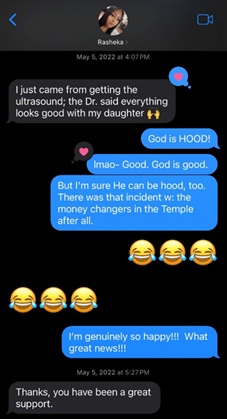
I accidentally typed “God is Hood!” to my work wife, Rasheka, upon news that her daughter was healthy and happy. I still laugh about that, and thanks to the wonder of screenshots, this was back in 2022.
Do you have anything specific that you want to say to your readers?
Thank you for being willing to sit with this story.
Laurel’s Diary is not an easy book, and I know that. It asks readers to stay present with pain, confusion, contradiction, and the cyclical aftermath of trauma. I am deeply grateful to anyone who chooses to enter that space with care.
More than anything, I hope this book starts conversations that are honest, brave, and healing.
Connect with Gina online at
Website: https://subscribepage.io/UdEnOL
TikTok: https://www.tiktok.com/@ginadwrites
Instagram: https://www.instagram.com/ginad_writes
Facebook: https://www.facebook.com/GinaDWrites
Laurel’s Diary is available for purchase from Amazon.