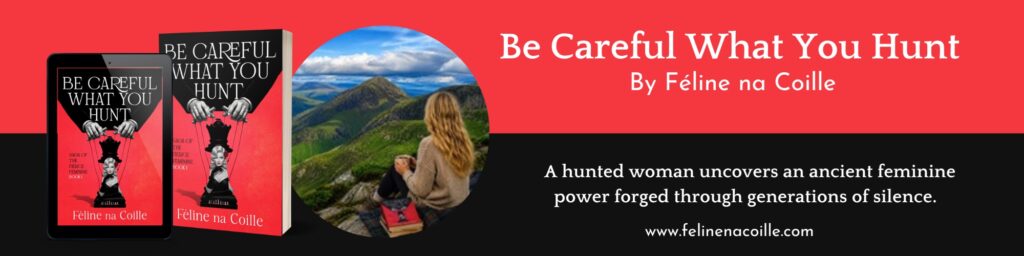
Féline na Coille is a Scottish-American author who writes in the space where myth becomes lived experience, silence becomes testimony, and survival becomes sovereignty. Her perspective is rooted in a lineage marked by persecution, resistance, and remembrance—from the shadow of the Scottish witch trials to the ancestral wounds carried through generations.
At the heart of Féline’s work is a calling to awaken readers from the spells cast on them by the intentional systems of division and manipulation keeping our world out of balance. Her stories blur the line between dystopian future and present-day mirror, pushing back against a world that seeks to label what it fears and silence what it cannot control. They encourage women to come back to themselves and to one another. To reclaim their voices, bodies, intuition, and power. To rise together as a force for restoring balance. In a world woven with untruths, where illusion is mistaken for order and separation is mistaken for freedom, she writes to repair what has been fundamentally broken.
Author Q&A
What is the name of your latest book and what inspired it?
My debut novel is Be Careful What You Hunt, the first book in the Saga of the Fierce Feminine trilogy. It was inspired by a question that stayed with me for years: What happens when women who were silenced are finally allowed to speak through their stories?
My family lineage traces back to the witches of Scotland, and even further—to the beginning of Scotland itself. Through wars, deprivation, persecution, and survival, the women of my clan endured unimaginable things. For generations, women had to hide their gifts from the world out of fear of being hunted, judged, or destroyed.
I’ve always been fascinated by that heritage—the mythology and spirituality—as well as the invisible threads that connect generations, including epigenetics. Rather than writing a fantasy where power is inherited through kingdoms or magic alone, I wanted to explore the idea that our greatest inheritance may be both the wisdom and the wounds passed down through the women before us.
At its heart, this book is about the power of being a woman—the beauty and the burden, the rage and the resilience, the intuition and the sacred strength that can coexist and define her experience. It also reflects the struggle of existing in a misogynistic society and how current events can sow the seeds for a dystopian future.
The novel grew into a story about survival, identity, remembrance, and discovery that the very thing the world tells you to hide may be the source of your greatest strength.
What genre do you consider your book?
Be Careful What You Hunt is what I like to refer to as genre-bending.
I guess I’d describe it as a dark fantasy with a dystopian and supernatural vibe that has elements of Celtic spirituality, Scottish mythology, psychological suspense, mythic fiction, and speculative fiction woven throughout.
If you enjoy morally complex characters, ancient lore, feminine power, and stories where emotional battles are just as important as physical ones, you’ll likely feel at home in its pages.
Is there a message in your novel that you want readers to grasp?
More than anything, I hope readers are left believing that our scars do not disqualify us from our purpose—they often reveal it.
The novel explores power, control, manipulation, generational trauma, resilience, and the quiet strength that can exist even after profound suffering. It is also about questioning the stories about ourselves that we inherit, especially the ones that tell us to stay small, stay silent, or stay afraid. Sometimes the harshest prison is the one we unknowingly accept as real and never attempt to escape.
I want readers to remember that what has been hidden, suppressed, or shamed within them may actually be where their deepest power lives. I hope they feel called to reconnect with their ancestors, to ask for guidance back to their true path, and to recognize the innate beauty that flows through them.
Every culture carries a story, and that story lives inside us. When women remember who they are and come together, I believe we have the power to heal not only ourselves, but the world around us.
What was the hardest part of writing your book?
The hardest part for me wasn’t writing the story. It was trusting it as it came.
It was trusting that if I wrote it honestly, women would hear the call within it—the call to come together, to remember their own magic, to heal, and to reconnect as we once did before we were pulled apart and separated by fear, judgment, and difference.
There were moments when I wondered if readers would be comfortable with the symbolism, the darkness, the spirituality, or the way the book refuses to fit neatly into one genre. But every time I considered softening it or simplifying it, the story reminded me what it wanted to be.
Culture, identity, trauma, ancestry, the soul, and the dark feminine all live inside this book. Those themes are not always easy to write because they require honesty. They require looking directly at the things many people are taught to avoid.
Learning to trust the story also meant learning to trust my own voice.
How much of the book is realistic?
The book is very real in the way that matters most: emotionally and spiritually.
Although the world itself is fictional, it highlights the emotional transformation that lives inside all of us. It unravels fear, intimacy, control, grief, hope, and the painful realization that the world is changing around us.
It also compels us to dive into the darkness of the shadow. At times, that shadow can swallow you whole. It comes in waves, and sometimes those waves can pull you under. But if you trust your ancestors, trust yourself, and remember the strength that has always lived within you, you can find your way back to the surface.
The fantasy elements simply gave me another language to use in exploring human nature, trauma, resilience, power, and the strength we often discover only after we have been pushed to our limits.
What is your favorite word, and why?
My favorite word is remembrance. Not simply remembering facts, names, or events, but remembering who we are beneath the fear, expectations, conditioning, and generations of silence.
To me, remembrance is an awakening. It is the process of peeling away the illusions and the masks we have worn to survive until we rediscover our truest selves. It is remembering that we are not separate—that we are deeply connected to one another, to our ancestors, and to Mother Earth herself.
I believe we have forgotten that every tree, every river, every stone, every woman, every culture, and every generation carries a story. When we remember our place within that living web, we begin to understand that healing ourselves also helps heal those around us.
Much of Be Careful What You Hunt is about remembering what has been forgotten, reclaiming ancestral wisdom, and honoring the voices that were silenced before they could be heard. It is about seeing beyond the illusion of separation and recognizing that we are all threads woven into the same tapestry.
My hope is that readers close the book with a deeper sense of belonging—to themselves, to each other, and to the world that has always been waiting to welcome them home.
Do you have any unusual writing habits?
Absolutely. Every writing session begins the same way—with a cup of tea, as any Scottish woman would do. But, for me, writing is more than sitting down at a keyboard; it is a ceremony.
Before I begin, I drum. I sing. I listen. I feel for a shift in the energy, the way my ancestors before me may have done. I take a quiet moment to ground myself and call upon them for guidance, inviting them into the creative process.
I ask them to guide my words, to help me tell the stories they were never given the chance to tell, and to carry forward their hopes, dreams, wisdom, and resilience through my writing. actually
Whether you believe in ancestral connection literally or metaphorically, I believe we all carry the echoes of those who came before us. Writing becomes my way of honoring that lineage and giving voice to generations whose stories have been forgotten, silenced, or rewritten.
I’ve learned that stories have their own rhythm. My job is not to force them—it is simply to listen.
Connect with the Author Online at https://felinenacoille.com/
Be Careful What You Hunt is available for purchase from Amazon at https://www.amazon.com/Careful-What-Hunt-Fierce-Feminine-ebook/dp/B0H3WXNB95