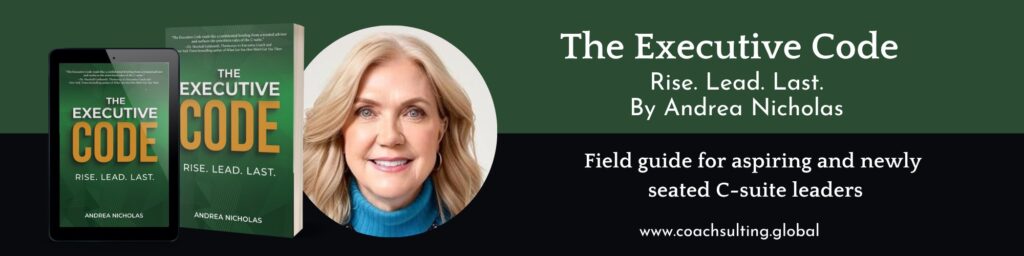
ANDREA NICHOLAS is a trusted advisor to C-suite executives leading under sustained visibility and consequence. She brings more than three decades of experience across consulting, executive leadership, and entrepreneurship, and is the creator of the Coachsulting® method, helping leaders expand influence, sharpen judgment, and build legacies that endure.
Author Q&A
What is the name of your latest book and what inspired it?
The book is called “The Executive Code: Rise. Lead. Last.” It was inspired by three decades of watching senior leaders step into roles where they weren’t just influencing teammates, an enterprise, or a board, but also industry bodies, trade groups, regulators, investors, Wall Street analysts, and competitors who respond to every move they make. At that altitude, the stakes are higher, the scrutiny is relentless, and yet most people are still handed leadership advice meant for middle management; this book is meant to close that gap and give them a realistic code for operating at the very top.
What inspired you to write your first book?
The Executive Code came from seeing too many leaders walk into their first top role with only a partial map. They knew how to perform, but they hadn’t been prepared for the real tests: reputation-threatening crises, silent power struggles, cultural riptides, activist investors, and the internal questions that surface when your job starts to swallow your identity. Over half of first-time C‑suite leaders falter in their first 18 months, per a recent McKinsey study. Many discover only after they arrive that the game is more about influence, impact, political navigation, and purpose than pure performance. I wanted to create an honest field guide that lays out the terrain and educates leaders – the nuance of PE‑backed firms, navigating cultural dynamics, building relationship capital, overcoming political situations, knowing when and how to exit, and more—so people can decide, eyes wide open, whether this life is truly for them and, if it is, how to succeed without breaking themselves.
Is there a message in your book that you want readers to grasp?
Yes: the C‑suite is a different game, and it’s not for everyone, and that is okay. “The Executive Code: Rise. Lead. Last.” makes it clear that the top roles are as much about strategic influence and enterprise‑level impact as they are about functional excellence; your audience is shaping industries, signaling to markets, and indirectly moving policy through the way they show up. The deeper message is that you must be intentional about your career design: anchor to purpose, be committed without letting the job become your entire identity, assess your longevity honestly, and understand that choosing not to pursue or remain in the C‑suite can be a deliberate, intelligent decision, not a failure.
How much of the book is realistic?
The book is entirely grounded in reality. It deals directly with the pressure, scrutiny, and reputational risk that come with being at the top, as well as the victories, breakthroughs, and moments of deep fulfillment that keep people in the game. The stories are drawn from real emerging and seated C‑suite leaders and board members; details are changed for confidentiality, but the situations are not sanitized. You’ll see the late-night “Is this worth it?” questions, the career-defining crises, the political missteps, and the recoveries, because an honest field guide has to show the terrain exactly as it is, not as we wish it were. We genuinely do learn more from our mistakes than our wins, and the book leans into that.
Are experiences based on someone you know, or events in your own life?
The experiences come primarily from years of close work with emerging and seated C‑suite leaders and board members in multiple contexts—public companies, PE‑backed firms, and high‑growth environments—combined with private coaching conversations where leaders can drop the script. The book distills recurring themes around self-awareness, power, politics, ambiguities, the pace of business, relationships, etc. Individual examples are anonymized and often composited, but the situations, e.g., volatile markets, political crossfire, board pressure, reputational risk, exits, and transitions, are pulled straight from real careers and real decision points.
What were the challenges (research, literary, psychological, and logistical) in bringing it to life?
The psychological challenge was deciding to speak plainly about things that are usually whispered about: the relentless pace, the demands, expectations and pressures of the top roles, and the toll on personal stamina and relationships. It’s one thing to coach someone privately through an M&A integration; it’s another to write about the dynamics in a way that’s honest but still respectful and useful. Logistically, the challenge was turning years of experience into a clear, practical guide structured to the sequential progression of a career, including what’s next as we face technological advancements like AI and robotics. The literary challenge was staying disciplined about relevance: every chapter had to earn its place by preparing readers for the reality of the role, not just entertaining them with war stories.
What was the hardest part of writing your book?
The hardest part was choosing to show the C‑suite as it actually is, not as people like to present it on stage or on LinkedIn. That meant including the doubts, the misjudgments, the times leaders were one decision away from losing their role (or their reputation), and what they did next. It also meant being clear about the level of scrutiny, the pressure, and complexity. Balancing that honesty with a sense of possibility of showing that you can build a healthy, high‑impact C‑suite career, if you understand the rules of the game beforehand, required a lot of thought and careful writing.
Did you learn anything from writing your book and what was it?
Writing “The Executive Code” made two things stand out sharply. First, every C‑suite story is distinct—sector, timing, ownership structure, personality, culture—but the underlying patterns are remarkably consistent: how leaders handle the first 18 months, the way they approach purpose, whether they cultivate relationship capital, how they respond to volatility and political traps, and how consciously they manage their own perspectives and longevity. Second, the book confirmed that not everyone should aim for or remain in the C‑suite. The demands are specific and unforgiving. My role as the author is not to romanticize the top, but to unveil its real qualities, so readers can make informed decisions, improve their odds of success if they go for it, and step out gracefully if or when that’s the right move.
What does being a successful author look like to you?
Success, for me, is when “The Executive Code: Rise. Lead. Last.” becomes a practical, dog‑eared, coffee-stained playbook for people who are already operating at the top of performance and influence but want to push themselves to see how far they can go. If a reader can use it to decide whether the C‑suite is truly right for them, interview more intelligently for top roles, navigate PE‑backed dynamics, expand their influence across internal and external stakeholders, build invaluable relationship capital, and design a career that lets them last, both personally and professionally, that is success. The highest compliment would be hearing that someone pulled the book off their shelf again before a major transition, a volatile episode, or an exit, because it helps them think with more clarity and intentionality.
What is your best method or website when it comes to promoting your books?
The most effective way to promote this book is to meet serious leaders where they already are, in formats that respect their time and intelligence. I do guest speaking for executive teams, leadership offsites, and industry events; I’m frequently interviewed on business podcasts where we talk candidly about power, boards, PE dynamics, and the real demands of the C‑suite; and I’m active on LinkedIn, where a community of over 10,000 professionals engages with the ideas behind “The Executive Code” through regular, insight‑dense posts. From there, more targeted efforts—select articles, interviews, and curated partnerships—help the book reach the people it’s written for: ambitious, discerning leaders who want a smarter,
Connect with Andrea Online at
Website: https://www.coachsulting.global
LinkedIn: https://www.linkedin.com/in/andreanicholasadvisor
The Executive Code is available for purchase on Amazon