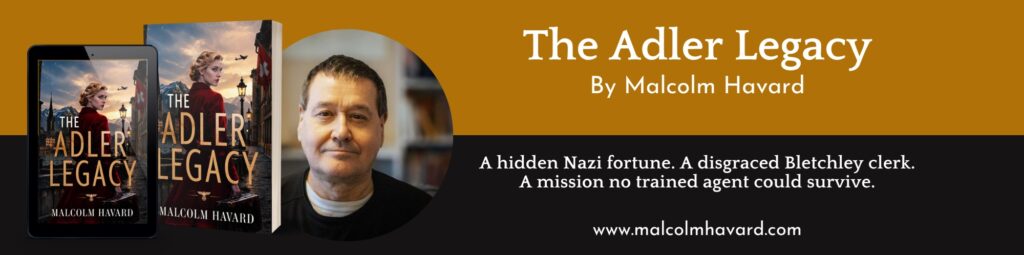
Malcolm Havard is an award-winning historical fiction author who writes stories from the World Wars to the Cold War. He has spent a lifetime gathering stories, living and working in Australia and the Middle East before returning to the UK. Today, he weaves that global experience into gripping historical novels that explore the intersection of crime, war, and espionage.
The Manchester Noir Series: Gritty 1990s crime with a unique twist (The Honey Talker, The Fatal Formula).
The Aviation Collection: High-octane tales of courage and dogfights in WWI and WWII (LMF, The Way Back, Leviathan).
The Lisbon Series : Follow ex-cop Dinis Lopes through the treacherous, “neutral” streets of 1940s Portugal.
Cold War Espionage: Revisit the 1950s with the fast-paced adventures of Contrail and Czechmate.
When he isn’t uncovering the secrets of the 20th century, Malcolm lives and writes in Cheshire, England.
Author Q&A
What inspired you to write your first book?
There’s a long answer and a short answer! Twenty years ago, my day job was in academia, although sadly not in history. My first three books were non-fiction business and academic textbooks, and at the same time I was completing my PhD thesis. By the time the books had been published and the thesis submitted and defended, I’d written something like a million words in three years. To fit it all around work, I’d fallen into the habit of writing before breakfast and editing in the evening. When everything was finished, I still had the writing habit but nothing left to write, so I turned to fiction and asked myself, ‘How hard could it be?’ Some seventeen years and twenty novels later, I think I’ve found out!
What authors, or books have influenced you?
Although I love Terry Pratchett and Douglas Adams for their humour, the author I have returned to most consistently over the years is Robert Harris. His ability to tell thrilling stories within convincing historical settings is something I have tried to emulate, particularly in my wartime Lisbon series, the Inspector Lopes books; The Gambler’s Daughter series, about SOE and SIS operations in occupied France; and my new series set against the Nazi ratlines in post-war Europe. I will never match Harris’s historical range, but I am very happy to follow in his footsteps. I also grew up reading Frederick Forsyth—I adore The Day of the Jackal—and John le Carré, both of whom have undoubtedly influenced my writing.
What genre do you consider your books?
I write twentieth-century historical fiction: intelligent, intriguing thrillers grounded in an accurate historical framework. They are the kind of books I most enjoy reading myself.
What is the name of your latest book and what inspired it?
My latest book is The Adler Legacy, the first in a new series. It sends my central character, Sophie Faulkner, undercover to expose a shadowy Nazi ratline smuggling war criminals from Germany and Austria into Italy and then out of Europe. Like many of my other novels, it was inspired by reading history.
I am a voracious reader of history, which is one of the main reasons I write historical fiction set in the twentieth century: the research is not a chore but a pleasure. Often, I come across a small historical nugget that makes me ask, ‘What if?’ That happened with the Lisbon books, when a historian mentioned evidence about whom the Duke of Windsor might have met while passing through the city in July 1940. It sent me down a rabbit hole that has so far produced four novels, a novella and a short story. The Gambler’s Daughter began with a passing reference to Inverlair Lodge in the Scottish Highlands—the original ‘cooler’—where agents who failed SOE training were sent until the secrets they held were no longer valuable. The Adler Legacy developed in much the same way. I read one book about the ratlines, then another, watched several excellent YouTube videos by Dr Mark Felton and realised just how many stories there were to tell.
That is one of the great strengths of fiction. The facts of history matter, but fiction can sometimes reveal the human depth of a subject—and its effect on the ordinary people caught up in it—in a way that factual accounts cannot. That is what I try to do.
How much of the book is realistic?
The historical framework is solid. I researched subjects ranging from the involvement of the Catholic Church and the intelligence services of the US and UK to the murky world of Swiss banking. Within the intelligence services, some people were trying to bring war criminals to justice while others in the same organisations were actively recruiting former Nazis to strengthen the post-war fight against communism. The story’s main characters are largely fictional, although some were inspired by real people.
I’m currently planning the sequel. This will bring more real characters into the story.
What were the challenges (research, literary, psychological, and logistical) in bringing it to life?
There is always a risk when writing a novel that has required extensive research: what I call ‘showing your homework’. By that, I mean the temptation to show readers how much effort has gone into getting the facts right. If the research becomes too visible, the story itself can get lost. The challenge is to create a convincing historical framework without sacrificing an entertaining narrative. Robert Harris handles that balance exceptionally well, which is one of the reasons I admire his novels and try to follow his lead.
Do you ever experience writer’s block?
No!
Do you write an outline before every book you write?
Not to the extent that I once did, but yes, I always begin with an outline. I am very good at finishing drafts; there are only a couple of books that I have started and not completed. I believe that is because I spend a fair amount of time working out the story I want to tell and the broad arc from beginning to end. That process also reveals which characters I need and what their motivations must be. By the time I sit down to write, I have a rough road map in the background to guide the direction of travel.
Essentially, I finish books I start to write not because I know every detail but because I know what the destination is. I think this is essential for a consistent writing output.
Do you use any special writing software? If so what is it, and what are a few of your favorite perks of it?
It’s probably easiest to go through my writing process. For the last three years I have been handwriting my rough drafts on a Remarkable paper tablet. This is then converted to text and exported to Scrivener. I find Scrivener excellent for viewing the whole novel at once which allows me to spot gaps and/or areas that need rewriting or shuffling. Once I have a complete draft I export to Word for editing. Sometimes I send a copy to Kindle so I can read the novel in its entirety to see if it hangs together. Finally, the draft is exported into Kindle Create for formatting.
Connect with Malcolm online at
Website: https://malcolmhavard.com
Facebook: https://www.facebook.com/people/Malcolm-Havard-Historical-Novelist/100056951479358
X: https://x.com/MalHavardWriter
The Adler Legacy has a release date of November 17, 2026 and is currently available for pre-order on Amazon. https://www.amazon.com/gp/product/B0HKJRZXLH