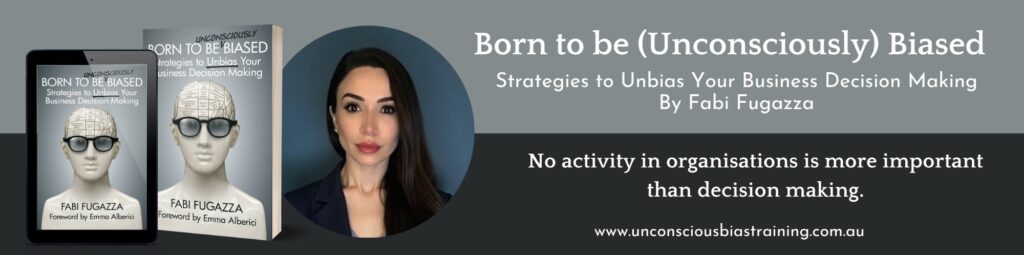
Fabi Fugazza ANZAM LLB BBusComm MMgmt GDLP is a management expert, author, international academic and lawyer with extensive experience in equity initiatives, human/civil rights and organisational management.
She has owned unconscious bias consulting and training business jObjective since 2018, is Co-Executive Director of the Italy-based human/civil rights coalition CILD and is a multi-award-winning academic at two universities based in Australia. She has taught unconscious bias, law, business, and social sciences in undergraduate and graduate programs across three continents, and in executive education programs. She is a former Lead Scientific Adviser of New York University’s Public Interest Law Clinic in Paris, has delivered several CPDs on unconscious bias, and has worked with non-profit organisations for over 15 years.
Author Q&A
What is the name of your latest book and what inspired it?
It’s called Born to be (Unconsciously) Biased: Strategies to Unbias Your Business Decision Making. The inspiration came from a few places. The “Born to be” was to accentuate the quiet part out loud; that it affects EVERYONE, and that it’s a natural thing. Over the past decades this phenomenon has gained so much attention but I notice many still struggle to accept the reality of their own bias because it feels like bias is something you catch if you’re a bad person, rather than being a cognitive reality for everyone. Bias is a natural phenomenon and actually has several great and valid uses for all of us (even for the most fair of people!). My argument really is just that it needs to be counteracted actively in certain decision-making contexts that it shouldn’t be so dominant in.
The “Strategies to Unbias Your Business Decision Making” was to just ensure that the practical focus of the book was clearly acknowledged upfront. This is not a philosophical or purely academic book. It’s a book about what you can do about it. That is the core focus of the book.
So the title is essentially: we’re all born with it. Now here’s what to do about it.
What are you working on now?
One thing I’m working on is further research into unconscious bias, which asks the question of why organisations are struggling to translate knowledge of unconscious bias into strategies to address it. Writing the book brought a real puzzle to the forefront for me: unconscious bias training is everywhere now, and plenty of leaders now really understand the concept, yet the actual process change inside organisations, the way people are hired, evaluated and promoted, for example, are changing far more slowly, if at all. There’s an awareness/action gap so I’m looking at that in more depth. Alongside that, I’m still doing my teaching, speaking and other work, so there’s never a dull moment.Is there a message in your novel that you want readers to grasp?
A big one is a bit of a wake-up call; that “merit” is far more subjective, and less straightforward than we like to admit. In defending decisions as “based on merit”, people often do not realize that this word is so much more subjective that its reputation leads you to believe. Ask five people on a hiring panel what merit means in terms of how the perfect candidate would show it, and you’ll get five different answers, and that’s fertile ground for bias.
My other message is more hopeful: you can’t be completely cured of bias, but you can get better at managing it, the same way you get fitter by going to the gym. If you stop putting in the work, the progress fades. It’s never about achieving perfection; it’s about improving over time. If readers finish the book and start internally questioning “why did I/we reach this conclusion?” and asking “what safeguard could I put in here to make sure I’m making the best decision possible?”; I’ve done my job.
What is your favorite quote?
There’s a line often attributed to Carl Jung, that I mention in the book and really like. Technically it’s a famous misquote, which I also flag in the book, but the misquote goes: “Until you make the unconscious conscious, it will direct your life, and you will call it fate.” In a business context, I put a bit of a spin on the quote by saying that until we make the unconscious, conscious it will direct your business decisions, and you will call it merit. I love it because it captures the whole premise of my work in one sentence. So much of what drives our decisions sits below the surface, and until we drag it into the light, we’ll keep mistaking our reflexes for logical reasoning.
What is your favorite genre to read, and why?
I’m a nonfiction reader at heart. I love to learn about how people think and behave. I love a good biography, particularly. There’s something so fascinating to me about knowing where a person that I think has had an interesting ride through life has ended up, and the ability of a biography to show you something about how they ended up there. I also find people reflecting on their own decisions to be fascinating. Some really reflect on reality and are frank with themselves and errors they made. In others, it’s clear that their mind has worked overtime to apply some rose-colored glasses in retrospect. I find the gap between how we believe we make decisions and how we actually make them endlessly fascinating, and biographies add a layer where people reflect on past decisions, which makes for a compelling “story time” of human decision making from many angles.
What does being a successful author look like to you?
For me it’s making people think. That is the true success of a book. A different perspective. A new action item. For me, success is a reader pausing before their next big decision that will impact other people, and asking themselves “how do I actually know this is the right choice?” That moment of self-reflection, multiplied across many readers and many organisations, is the whole point.
I wrote the book because I think unconscious bias deserves far wider attention than it gets, given it sits beneath so many social issues and human rights issues and under so much organisational underperformance. If the book gets a few people talking about bias without shame or defensiveness, and each of them take even one tiny step towards better decision making (then hopefully another) that is gold for me.
Connect with Fabi online at
Website: https://www.unconsciousbiastraining.com.au
LinkedIn: https://www.linkedin.com/in/fabi-fugazza
Born to be (Unconsciously) Biased is available for purchase at https://www.amazon.com/Born-Unconsciously-Biased-Strategies-Business-ebook/dp/B0DZY4QF2M