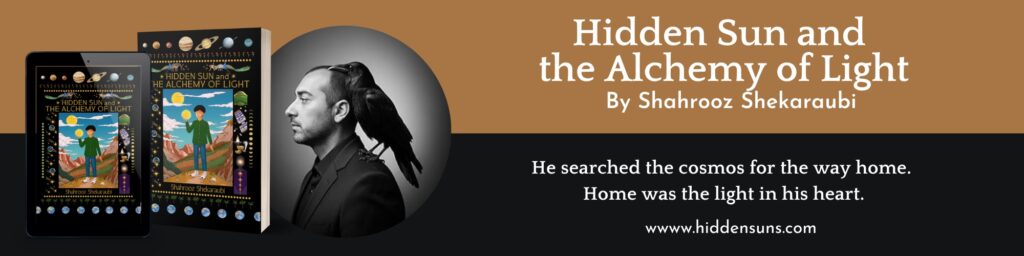
Raised between languages, cultures, and continents — born in Tehran and coming of age in the suburbs of Washington, D.C. — Shahrooz Shekaraubi grew up navigating identity, displacement, and the quiet ache of not fully belonging anywhere. A lifelong student of philosophy, poetry, and inner transformation, he channels these questions into fiction that explores light, shadow, and the human search for meaning. Hidden Sun and the Alchemy of Light is a debut novel six years in the making.
His writing sits at the intersection of Myth, Inner Alchemy, and Cosmic Fantasy — asking what it means to remain luminous in a world shaped by noise and division. At the heart of his work lives a single question: how can we create a world that remind people of the light they already carry?
Author Q&A
Tell us a little about yourself. Where were you raised? Where do you live now?
I was born in Tehran. I grew up in the suburbs of Washington, DC from the age of one. I live now in Manassas, Virginia, when life permits me to stay still — which is rarely. Right now I am in Bali. Bali still knows something about silence that most places have forgotten.
But the real question is never where. The real question is, who is the one who has lived in all these places? That one is much harder to find.
My childhood was the soil this whole life grew from. My parents worked hard, as immigrant parents do — they were saving us a future, which meant they were not always present in the moment. I spent long hours alone with my own mind. Insecurity, confusion, loneliness, daydream, wonder. That is the honest list. The more I wanted to fit in, the more clearly I was made the other. The world I was offered felt too small for me. So I began to build another one inside.
This is how artists are made. Not through ease, but through the secret pressure of not-belonging. The child who cannot find a place in the visible world begins to draw, and write, and dream, and slowly opens a place for himself in the invisible one. I was that child. I have been an artist for as long as I can remember, though no one had yet given me the word for it.
When the pandemic came, I lost almost everything I had built on the surface. Money, work, the version of myself I had spent years constructing. The losses tore the costumes away, and what remained underneath was older than the losses — that same lonely immigrant boy, still carrying a quiet sadness, still mistaking it for himself. Existence, in its strange kindness, had to take everything from me before I would finally turn around and look at him.
This time, I did not look away. And the artist who had been hiding inside him began, at last, to speak.
That looking is where the book begins.
What inspired you to write your first book?
Inspiration is not quite the right word. The book was not an inspiration. It was a wound learning to speak.
When the pandemic came, I found myself at a crossroads and it is the same crossroads every human being arrives at sooner or later. You can keep running from your shadow, and the running becomes your whole life. Or you can sit down, turn around, and face the thing that has been following you. Most people run. The shadow does not mind. The shadow is patient. It will wait.
I stopped running. I sat down with the child inside me, the boy in Virginia who had wanted so badly to belong and had quietly decided he never would. He had been daydreaming his way through life because the world he was offered was too small for him.
I wanted to write him a story. Not to teach him anything. Just to keep him company. A boy. A carpet that turned out to be alive. A doorway into a cosmos that had been waiting all along.
How did you come up with the title?
The sun does not disappear when night comes. The sun is on the other side of the earth, busy with another sky. We say the sun has set, but really, we have turned away. This is true of the inner sun as well. The light is not gone. We are simply looking elsewhere.
Alchemy is the old name for the turning back.
The title was not chosen. It was a description of what had already happened.
How do you come up with names for your characters?
There is an old understanding, almost lost now, that a name is not a label. A name is a vibration. When you name a thing rightly, you are not deciding what it is. You are recognizing what it already is.
The boy is called Mihryar. In Persian, the name means light’s compassion. The first time I wrote it down, I felt the word press itself into the page. He grew into those syllables, and by the end I could not call him anything else.
There are other names in the book, and they arrived the same way. Not by invention. Many came after meditation, when the noise of the mind had finally settled and something quieter could speak. Others came in dreams, fully formed, as if delivered from somewhere far older than me. I would wake and write them down before they could fade.
The book was shaped by many rivers. Persian roots, of course — that is the soil I come from. But also the wisdom of Native American traditions, the deep memory of ancient Babylon, and, strangely, the cosmic reach of science fiction films. The old stories and the future stories speak the same language, if you listen for it.
I do not invent names. I wait for them to introduce themselves. The mind cannot create them. The mind can only combine. The real names arrive from the place beneath the mind.
What genre do you consider your book?
Mythic fiction, if we must put it in a box. But all real stories are mythic. They speak the older language, beneath the language of the newspaper. This book is written for a child, and for the child still living inside the adult who has forgotten he is one. It is closer to a flying carpet than to a manual.
Is there a message in your novel that you want readers to grasp?
You ask about message. I want to be careful here. The moment a story carries a message, it stops being a story and becomes a sermon. And the world is already drowning in sermons.
A story does not deliver a meaning. A story creates a space. The reader enters the space and finds whatever they were already carrying.
If you ask me what I hope is met inside Hidden Sun and the Alchemy of Light, I will say this. What makes you feel invisible is not the truth of you. The shame you carry was placed there by other hands. It is not yours. It can be set down. And inside you, there is a sun that has not gone anywhere, no matter how long the night has lasted. Courage is not a great act. Courage is the small motion of turning toward that sun.
But these are not lessons the book teaches. They are feelings it travels through, and you travel with it.
What was the hardest part of writing your book?
To stay honest. This sounds simple. It is the most difficult thing a writer can do.
Books for young readers are often dishonest, even when they are kind. They flatten the world into something children can manage. But children are not stupid; they know the world is heavy. When you pretend otherwise, they feel the lie, and they learn not to trust stories.
I wanted Mihryar to feel a real loneliness, a real shame, a real fear of being unseen. Only then could the cosmos he steps into mean anything at all. Wonder is not real until it is placed against the weight of the ordinary.
But here is the deeper truth. To write Mihryar honestly, I had to face myself. There is a scene in the book where the boy stands before a mirror and meets his shadow self — the part of him he has spent his life trying not to see. Every time I wrote a scene, I had to do the same. I had to turn and look at what I had been avoiding in myself. I could not write the boy through that door if I refused to walk through it myself.
The writing became a kind of therapy. It became a meditation. It became a slow, unglamorous spiritual practice. And let me say it clearly, because the spiritual marketplace will not: spiritual growth is painful. The light does not arrive without cost. The shadow does not retreat without first being seen.
The hardest part of writing this book was not the craft. It was not the editing. The hardest part was not flinching — from what the boy felt, and from what I felt while writing him.
Did you learn anything from writing your book, and what was it?
You begin a book thinking you are the writer. By the end, you understand the book has been writing you. This is the secret no one tells you.
I began Hidden Sun and the Alchemy of Light to give my younger self a guide. I finished it having become more of an adult to him. The pages were the room where that meeting could finally happen.
A few things stayed with me.
Shame is unmet grief in a costume. When you finally meet the grief, the shame quietly leaves the room.
The shadow is not your enemy. It is the part of you that has been waiting longest to be loved.
And the inner sun is patient. It does not punish you for the time you spent in the dark. It simply waits for you to turn.
What behind-the-scenes tidbit in your life would probably surprise your readers the most?
I wrote much of this book in motion. Different cities, different rooms, different floors. The carpet in the story is, in some sense, the floor I kept arriving at. Wherever I was, I would sit down on it, and the boy would be waiting. The book, I have come to think, was less written than visited.
How can readers discover more about you and your work?
Hiddensuns.com. The book is in print, in ebook, and as an audiobook on Spotify, Apple Books, and Google Play. For me, the audiobook is the closest cousin to the way stories were originally meant to live — a voice, a listener, and the dark gathered around the fire.
Connect with Shahrooz Shekaraubi Online at
Author website: https://hiddensuns.com
Instagram: https://www.instagram.com/hiddensunandthealchemyoflight
TikTok: https://www.tiktok.com/@hiddensuns1
YouTube: https://www.youtube.com/@HiddenSuns
Hidden Sun and the Alchemy of Light is available for purchase on Amazon.
https://www.amazon.com/Hidden-Alchemy-Light-Shahrooz-Shekaraubi/dp/B0GS8PG7YJ