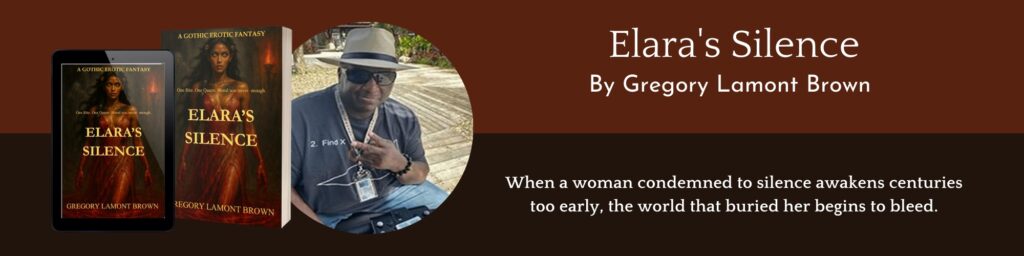
Gregory Lamont Brown is the author of The Hollow Gospel Chronicles , a dark epic fantasy series centered on prophecy, inheritance, and the politics of memory. Raised in Chicago, Brown writes immersive, character-focused fiction that examines how power is preserved-and how it is challenged.
His work combines gothic atmosphere with structured mythic systems, exploring supernatural dynasties, ritual law, and the fragile architecture of legacy. Elara’s Silence marks the opening installment of a planned multi-book series.
Author Interview
Tell us about yourself and how many books you have written.
I am a Chicago raised storyteller and the creator of The Hollow Gospel Chronicles. Elara’s Silence is my debut novel and the first installment in what I intend to be a multi book dark epic fantasy series centered on prophecy, inheritance, and the struggle over who controls memory.
Before stepping fully into fiction, I served in the United States Army, an experience that shaped my understanding of discipline, leadership, and consequence. Years later, I survived a stroke that forced me to rebuild not only my health but my sense of identity. That period of recovery changed the way I think about resilience, legacy, and the fragility of time. Those themes are woven deeply into my work.
I hold a Master’s degree in Instructional Technology and an MBA in Marketing, and I currently serve as a federal employee as well as Vice President of Communication for my AFGE federal union. My professional life has been rooted in systems, structure, and advocacy. My creative life explores what happens when those systems fracture.
So far, I have written one published novel, with multiple installments already in development. This series is not just a story to me. It is the culmination of service, survival, study, and the decision to build something that lasts.
What is the name of your latest book and what inspired it?
My only completed book is Elara’s Silence. It began with a question that would not leave me alone: What if prophecy was not something you received, but something someone wrote? That idea opened the door to a world where scripture is alive, history is controlled, and one woman’s return threatens the structure of power itself.
But the true inspiration runs deeper than a single concept.
My wife, Denise Shanta Brown, was my first and most important inspiration. Many of the early conversations that shaped this world came from long talks with her about love, destiny, legacy, and the cost of silence. She believed in the story before it was fully formed. Her faith in me gave the idea weight.
My life experiences also shaped the tone of the book. Service in the Army, surviving a stroke, rebuilding identity, understanding how fragile and powerful time can be — those realities gave the story its emotional foundation. Themes of loss, resilience, and inheritance are not theoretical to me.
I have also always carried a deep fascination with vampires. Not just as monsters, but as symbols of lineage, immortality, and power preserved across centuries. That fascination grew alongside my longtime creative companion, Louis Rivera, who has been both muse and worldbuilding partner. Many of the political structures, mythic layers, and character tensions were sharpened through our conversations.
Elara’s Silence is the result of love, survival, imagination, and a lifelong obsession with myth. It is not just a fantasy story. It is the convergence of everything that shaped me.
Do you have a specific writing style?
I write dark, character driven fantasy built around layered political systems and emotional consequence. My work blends gothic atmosphere with intimate internal conflict, because I am less interested in spectacle than in what power costs the people who hold it.
A lot of my ideas begin in dreams. I often see fragments of worlds, symbols, or moments long before I understand how they fit together. When I sit down to write, I try to translate those visions onto the page and then ground them in human truth. I draw from the flaws and beauty I see in people, in places, and in my own lived experience.
I care as much about what a character loses as I do about who wins the battle. For me, the heart of the story is not the clash itself, but the scar it leaves behind.
Is there a message in your novel that you want readers to grasp?
At its core, Elara’s Silence asks who has the authority to define truth and who pays the price when that authority goes unchallenged. The novel explores inheritance, power, and the cost of silence, but those ideas live most intimately within Elara’s journey.
The story follows her development as she confronts a world designed to erase her. She is not just fighting political systems or supernatural dynasties. She is fighting her own undoing. She is resisting the version of herself that others tried to define, contain, or extinguish.
If there is a message, it is this: systems endure because people accept them. But they fracture when someone refuses to disappear. If readers walk away not only questioning inherited structures, but also reflecting on their own capacity to resist erasure, then the story has done its work.
What was the hardest part of writing your book?
The hardest part was finishing it without my wife, Denise Shanta Brown, here to see it.
She was not just my inspiration. She was my partner in the beginning of this world. Before there were chapters or outlines, there were conversations between us. Long talks about power, love, destiny, legacy. She believed in Elara’s Silence when it was still just an idea forming in my head. She saw something in it before it fully existed.
There is a quiet kind of pain that comes when you finish something and realize the person you most want to share it with is not there.
Completing this book became more than finishing a manuscript. It became a promise I had to keep. Every page carries her presence in my memory. Every chapter reminds me that this story was born in shared imagination. Finishing it was not about achievement. It was about love.
Loss, memory, legacy. Those are not themes I researched. They are part of my life. This book stands because she believed it should. In many ways, it belongs to both of us.
What are your current projects?
I am continuing The Hollow Gospel Chronicles with Book Two, The Moon That Broke the World, and Book Three, The Shadow Throne That Remembers. With each installment, the mythology behind the Gospel deepens and the consequences of prophecy grow more personal and more dangerous.
The series expands beyond court intrigue into widening fractures between vampire dynasties, wolf bloodlines, and the hidden custodians who believe they alone have the right to shape destiny. What begins as a struggle over lineage and authority becomes something far more destabilizing as the Gospel itself begins to reveal its own will.
What books or authors have influenced your writing?
Joe Abercrombie, Eric Van Lustbader, and Guy Gavriel Kay have all shaped the way I approach storytelling in different but important ways.
From Abercrombie, I learned the power of moral complexity. His ability to ground epic conflict in flawed, painfully human characters showed me that grit and political realism can elevate fantasy rather than diminish it. Power feels more dangerous when the people wielding it are fully human.
Lustbader influenced the precision and intensity of my confrontations. His action sequences feel personal and psychological, never chaotic for the sake of spectacle. That sense of control and emotional immediacy shaped how I handle conflict on the page.
And from Guy Gavriel Kay, I draw inspiration in terms of atmosphere and emotional depth. His work carries a sense of history, longing, and quiet consequence that lingers long after the final page. He writes fantasy that feels lived in and remembered, and that resonance deeply informs how I approach legacy and memory in my own series.
Together, those influences pushed me to blend mythic scale with emotional gravity, ensuring that even the largest supernatural conflicts remain anchored in character, loss, and consequence.
What does being a successful author look like to you?
Success to me is building a world readers want to return to and expanding that vision beyond a single book or series. It is seeing characters resonate beyond the page and knowing the mythology feels real enough that people debate it and carry it with them.
It also means growing into a successful publisher. Through D and G Publishing, I want to create a platform that supports not only epic fantasy, but also sharp satire, thoughtful nonfiction, and bold science fiction. My goal is to build a body of work and a publishing home that lasts.
Longevity matters more to me than a single moment. I am not chasing noise. I am building something enduring.
How can readers discover more about you and your work?
Readers can find Elara’s Silence on Amazon, but the central hub for everything connected to the series is my website, www.d-g-publishing.net. There, readers can explore deeper insights into The Hollow Gospel Chronicles, follow updates on upcoming installments, and access exclusive content about the evolving mythology behind the Gospel.
The site also features a digital flipbook edition of Elara’s Silence, offering an immersive reading experience directly through the platform. It is where the world continues to expand beyond the printed page.
Elara’s Silence is available on Amazon. https://www.amazon.com/dp/B0GNDDQL8G