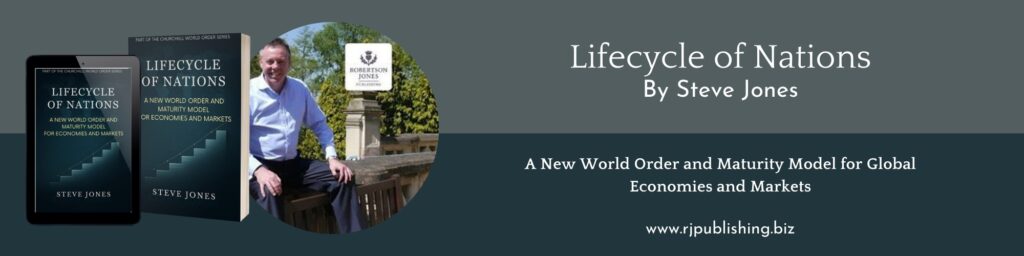
Steve Jones is an economist, entrepreneur, historian, and international analyst known for his commentary on geopolitics, trade, and global governance. He is the author of All to One – The Winning Model for Marketing in the Post-Internet Economy (McGraw Hill) and has advised governments, multinational institutions, and think tanks with his evidence based insights into the international system. After a successful corporate career with British Airways, EDS, Avis, and Accenture, Steve founded Sport4Kids, an innovative children’s sports education company. He is also the author of Fitness for Living, inspired by his own journey back to health after years in a sedentary executive lifestyle. Motivated by today’s global challenges, rising trade tensions, and his son’s interest in economics, Churchill, and Franklin D. Roosevelt, Steve is now writing a series of books exploring the origins of global governance and the geopolitical forces shaping the modern world. Today he is passionate about building a community that encourages adults to “fight the good fight” and grow younger together each year.
Author Interview
Tell us about yourself and how many books you have written?
Well, I’m a family man, two children and have a love for sport and historical geo-politics and economics. I have written four books, the first, a marketing book at the turn of the millennium called All to One with McGraw Hill. The last three are very recent and part of the Churchill World Order Series looking at historical lessons and potential answers for today’s chaotic economic and geo-political world.
What is the name of your latest book and what inspired it?
My latest is Lifecycle of Nations and looks at what could be a New World Order through the lens of a Maturity Model for Global Economies and Markets – the big idea is to reshape global trade behind a philosophy of Reciprocal Needs rather than Reciprocal Tariffs. That cooperation and collaboration would benefit all rather than zero sum nationalist and power-driven bilateral power plays. The inspiration was the vision of Churchill and Roosevelt and their Atlantic Chater creating a New World Order post World War two. The end game is to renew prosperity and peace for all countries, economies and all people in the face of rising nationalistic totalitarian forces and economic turmoil. The big hope is that Lifecycle of Nations is adopted and shapes international relations for the rest of the 21st Century.
How much of the book is realistic?
Interesting question – As a nonfiction book hopefully a great deal, but geo-politics can be fraught with competing views. Some of the constructs in the book look to the future and I would dearly love to have some of them brought to real life, rather than isolated though leadership pieces on their own. Being practical and brought to life would be a step in the right direction to making a difference. First, I suppose you have to write those thoughts, frameworks and ideas to share and contribute to the discourse on how to fix the current international chaos.
What authors, Leaders or books have influenced you?
Without a shadow of doubt, it is great leaders and thinkers that have influenced me most. Apart from Churchill, I think that Frankly D Roosevelt has been most inspiring. Through researching the book, I found these two great leaders were in turn influenced by other great leaders and visionaries in their historical past. Teddy Roosevelt, Abraham Lincolnd as well as George Washington and the original Founding Fathers are included in that.
What are you working on now?
I am working on, perhaps, an even more critical challenge to the 21st Century in Artificial Intelligence, and its opportunities and threats to individuals, communities and nations. The working title is Lifecycle of Intelligence – AI, Artificial Power and the Future of Nations. Basically, how can applied history, constitutional principles and perhaps a new AI Charter shape a fairer technological world order? It is positioned as a follow up on Lifecycle of Nations with a deeper dive into AI – Watch this space …
What is your favorite quote?
It has to be one of Winston Churchills, there are so many but my favorite, one which I used in the book is “A pessimist sees the difficulty in every opportunity; an optimist sees the opportunity in every difficulty.” I’d like to think it describes myself and what I aspire to be.
Which famous person, living or dead, would you like to meet and why?
Winston Churchill is top of my list. Although Muhamad Ali would come a close second. I have gone through such a journey researching and writing about Churchill’s vision, passion and sheer will-power, that I would like to experience some of that first hand. What is more of a surprise is that in seeking historical insight to deal with today’s challenges, I have turned it into using, not the actual scripts and values but the constructs Churchill and Roosevelt used for crafting a better future. I have so many questions that I would love to get answers to. I see Churchill, in a sense, a team mate and a mentor for coming up with the forward looking constructs to craft a better peaceful and more prosperous 21st Century. – I would love to get his take on that as we look to make a difference in amongst the current turmoil.
How can readers discover more about you and you work?
Well apart from the books, on sale at Amazon https://www.amazon.com/dp/B0GP88N5KD and other retailers, is our website https://rjpublishing.biz/churchillworldorder/ There is a Special Free Bonus on there which is a mini book looking at Churchill’s Leadership Lessons from American Presidents – Five Timeless Leadership Lessons from America’s Greatest Presidents. We will also keep everyone updated on all our latest developments and book launches.