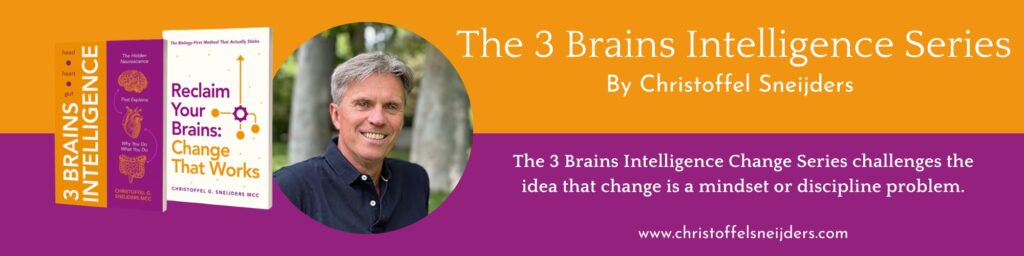
Christoffel Sneijders is an executive leadership coach, trainer, and creator of the 3 Brains Intelligence framework, a neuroscience-based model that explains why intelligent, capable people still struggle with burnout, conflict, and stalled change. With more than 30 years of experience working with leaders and organizations across Europe, the Middle East, Asia, the USA, and Australia, he has consistently observed that insight and willpower alone are not enough to create lasting transformation. His work reveals that human decision-making is driven by three distinct centers, the Head, Heart, and Gut, each with its own priorities and survival patterns. When these three brains are aligned, sustainable change becomes possible. As founder of the 3 Brains Intelligence Academy, Christoffel trains coaches and leaders worldwide through ICF-accredited certification programs, translating complex neuroscience into practical, real-world tools that help professionals lead, decide, and perform with clarity under pressure.
Q&A
What is your book about?
This book is about why people keep repeating patterns they do not want, even when they understand themselves and even when they genuinely want to change.
It is for the person who lies awake at night replaying conversations in their head and still says the wrong thing the next day. It is for the leader who looks strong in meetings but goes home exhausted and emotionally disconnected. It is for the partner who gives and gives and then suddenly explodes or withdraws. It is for the high achiever who burns out, recovers, and then slowly builds the same pressure again.
Most people think this happens because they lack discipline or clarity. What I have seen over thirty years of coaching and working as a therapist is something different. We do not operate from one single brain. We operate from three brains, each with its own memory, capacity to make individual decisions, and strategies that help us flourish.
Your Head is responsible for analysis, logic, planning, and cause-and-effect thinking. Your Heart is responsible for connection, belonging, empathy, and emotional meaning. Your Gut is responsible for survival, self-protection, instinct, courage, and action.
When these three Brains work together, you feel consistent. You think clearly, you feel appropriately, and you act decisively. When one Brain dominates for too long, predictable patterns begin to form.
If the Head Brain dominates, you overthink, second-guess, and talk yourself out of action.
If the Heart Brain dominates, you people-please, avoid conflict, and fear rejection.
If the Gut Brain dominates, you become controlling, impatient, or reactive under pressure.
The problem is not that any of these Brains are wrong. The problem is dominance without balance.
These books help you recognise which Brain has been leading your life, which one has gone quiet, and how to bring them back into alignment so your decisions reflect all of you, not just one part.
What inspired you to start writing?
It happened in Perth during a coaching session with a woman who had been drinking 1 to 2 bottles of wine a day.
When I asked her why she drank, she looked at me and said she did not know. The best answer she could give was: it’s a habit, an addiction, and it is stronger than me. From the outside, she seemed to be functioning well. She had a good career and serious responsibilities for people who depended on her. But every evening she drank, and every morning she promised herself it would stop.
When we slowed down and went deeper, the real story emerged. At sixteen, she had been sexually abused by a friend of her brother. In her twenties, she had an abortion because the pregnancy was a mistake and she did not want to stay with the man involved. She had pushed both events away and continued living, but the emotional pain had never truly been processed.
What I saw in that session is something I have seen many times since. When emotional pain remains unresolved, the Heart and Gut Brain seek relief. The Gut Brain, which is responsible for survival and immediate action, does not sit and reflect. It takes action to soothe and numb the pain so that we can “function.” Addictions that create a boost of serotonin and endorphins are the most effective. For some people, that becomes food; for others, work, shopping, or real physical drugs like alcohol, cannabis, or XTC. The form differs, but the mechanism is similar. The body seeks relief; for her, it was alcohol, the easiest and fastest way to do that.
When we worked directly with the emotional memory and the survival imprint connected to those two experiences, something shifted at a level that had nothing to do with promising to drink less. The urge that had felt automatic lost its intensity because the pain it was protecting had been addressed.
When I saw her again, she said something that changed my life. After one session, she never touched alcohol again and threw all the full bottles out. For the first time in her life, she could say, “I love myself.”
She confronted me and said, “This work is too important to stay inside a coaching room; you have to write it down.” I replied with the excuse I had used for years, that I am dyslexic and writing is not my strength. She did not accept it. She stood up, walked towards me, and asked me directly what excuse I still needed if she could face her past and change her behaviour.
That moment was uncomfortable but honest. I realised I was doing exactly what I help my clients stop doing. I was hiding behind a belief about myself that no longer served me. I decided there and then that I would write the book, not because I suddenly felt confident about writing, but because I could no longer justify not doing it.
What makes your approach different from other self-help books?
Over the years, I have met many people who have done therapy, read widely, attended courses, and can describe their patterns in detail. They understand their childhood. They know their triggers. They can analyse their behaviour and even their feelings with impressive clarity. Yet under pressure, the same reactions return.
The difference is that I work with dominance and hierarchy between the 3 Brains. Our 3 brains have 3 different strategies and 3 different responsibilities. As I explained earlier, the head likes to find a logical solution. The heart likes to stay connected and wants to avoid rejection. The gut likes to be safe and likes to win.
To use a metaphor, you could compare it to 3 people in a room with 3 different strategies. If you want a solution, all 3 should be heard, and all 3 should work as a team. So it’s actually about listening to which of the 3 brains is dominant on this topic, which brains may be silent, and which brain might be stopping the desire to change.
If someone explains everything beautifully but cannot feel their sadness, the Head is dominant and the Heart is suppressed. If someone is endlessly compassionate but cannot say no, the Heart is dominant and the Gut is offline. If someone takes bold action but creates damage in relationships, the Gut is leading without enough Head and Heart integration.
From there, we get the blocks out of the way and find the solution together with the person so they can work as a team.
Most self-development methods add techniques. I change the internal leadership structure.
When you can recognise which brain is leading and which one is silent or against the change, change becomes far more precise. You do not tell everyone to “think positive,” “set boundaries,” or “take action.” You help the person bring the missing part of themselves back online so they are no longer operating as a one-system human being.
That is the difference. It is not another technique. It is a new way of understanding how decisions are actually made.
Who are these books really for?
For everyone who wants to get that burden off their shoulders, that critical voice inside their head. For people who feel conflicted, tired, or inconsistent and know they can overcome it, but have tried and are still stuck.
It can be the high achiever who keeps pushing while feeling emotionally empty, the executive who achieves targets yet feels disconnected at home. It can be the kind person who gives too much and then quietly burns out. It can be the intelligent professional who thinks and analyses but still struggles to act. It can be someone who keeps repeating relationship patterns they promised themselves they would stop.
If you recognise yourself as being strong on the outside and conflicted on the inside, this work will resonate. It is not written for people who want quick hacks. It is written for people willing to look honestly at which Brain has been running their life and what the cost has been.
You do not need to be in crisis to benefit. You simply need to recognise that part of you wants one thing while another pulls in a different direction.
These books are for readers who want something more honest than clichés and more practical than vague inspiration.
What is the biggest misconception people have about change?
That change is mainly about willpower, discipline, microhabits or get in the feeling
People try to force themselves into new habits using logic and repetition. Sometimes it works for a while. Then life happens. Stress, conflict, disappointment, fear, rejection, fatigue. I have seen people try to out-discipline a dominant Brain. A Head-dominant person will create more structure. A Heart-dominant person will promise to be stronger, find support for the change, and rely on others. A Gut-dominant person will push harder. In those moments, the part of the system responsible for survival takes over, and the old pattern returns. Many times, the result is exhaustion, loss of self-confidence and self-worth, and before you know it, people are saying to themselves that they are weak, do not have a spine, are losers, etc.
That is not true; the problem is that they have been trying to change using the wrong brain. They haven’t failed; their biology overruled them.
Once those 3 Brains are brought into alignment, change becomes sustainable because it is no longer one part of you fighting the other two.
Can you give an example people might recognise?
A very common example is someone who cannot say no.
The person whose Heart Brain has been guiding their life for as long as they can remember. They carried everyone’s emotions, said yes to every request, hid their needs, endured unfair pressure, and apologised even when they had done nothing wrong. They please, keep the peace, take care, and push through.
They are kind, helpful, and dependable, and everyone trusts them. But privately, they feel drained, resentful, and sometimes even trapped. They keep saying yes because they fear disappointing others or being viewed as selfish. Later, they are frustrated with themselves and wonder why they cannot simply be stronger.
In this situation, the Heart Brain, which is responsible for connection, is guiding the decision. The part responsible for self-protection and boundaries, the Gut Brain, is quiet. The person is not weak; they are simply overusing one internal system while suppressing another.
They learned in their upbringing that to stay connected with their parents and get praise and support, they had to put their own needs aside. When they started their own life, they never stopped that old mechanism they learned as children.
When they learn to reconnect with their inner strength and instinct, saying no stops feeling like rejection. It becomes self-respect. That is when their behaviour changes without them needing to become a different personality.
What do you hope readers experience after finishing your books?
I hope they feel understood and know it is not their fault, and that what they desire is achievable for them.
Most readers who pick up these books are already intelligent and self-aware. What they lack is a model that explains why they can understand themselves so well and still repeat the same pattern when stress hits.
When they recognise the intelligence of the 3 Brains and how their strategies, responsibilities, and dominance function, they often feel relief first. Relief that they are not broken, and relief that their behaviour has an explanation.
Then I hope they feel responsibility in a healthy way. When you can recognise what is happening inside you, you cannot unsee it. You start noticing the moment you are about to overthink, the moment you are about to people-please, the moment you are about to react from instinct without reflection.
That awareness creates choice, and choice is where growth begins.
Why does this framework matter now?
Because we live in a world that constantly triggers one-brain living.
In pressure-filled environments, people become overly cognitive and disconnected from feeling. In uncertain times, people become instinctive and reactive. In relational tension, people become overly accommodating or overly defensive.
We see it everywhere. At home, at work, online, in leadership, in relationships. People speak past each other because they are not operating from the same brain.
When you understand the Head, Heart, and Gut as distinct intelligences, you gain a practical language for self-awareness and communication. You can recognise what is driving you, what is driving the other person, and what is missing.
This is not just about personal growth. It is about making better decisions and creating healthier relationships in a world that keeps pushing us into extremes.
Visit Chris on his website at https://www.christoffelsneijders.com
The 3 Brains Intelligence Series is available for purchase on Amazon.
3 Brains Intelligence
The Hidden Neuroscience That Explains Why You Do What You Do
https://www.amazon.com/dp/B0GHHBBBSP
Reclaim Your Brains
Change That Works: The Biology-First Method That Actually Sticks
https://www.amazon.com/gp/product/B0GL3FJFJV